How to Choose a Wholesale iPhone Screen Supplier in 2026: A Sourcing Checklist for Repair Shops, Distributors & Refurbishers?
We manufacture iPhone LCD and OLED replacement screens in Shenzhen and ship to repair chains, distributors, and refurbishers across 20+ countries.If you're buying iPhone screens from China for the first time - or you've been burned once and you're shopping for a new partner - the hardest part isn't the price. It's working out who you're actually dealing with before your money leaves the country.
I've sat on the supplier side of this for over a decade, and I'll tell you the part most catalogs won't: a large share of the "factories" you'll meet on B2B platforms don't own a production line at all. They buy from people like us, repack, and resell. That's fine for a trial order. Once you're moving volume, that hidden middle layer is the difference between a 1.5% return rate and a 5% one - and in this trade, returns are where margins go to die.
So this is the checklist I'd hand a serious overseas buyer. No fluff, no "trust us."
Factory or middleman? Settle this first
Everything downstream - price, lead time, quality consistency, how problems get solved - depends on this one question. A genuine iPhone LCD screen manufacturer controls the bonding, the touch IC programming, the backlight, and the final QC. A trader controls a spreadsheet.
Here's how you tell them apart in the first two emails:
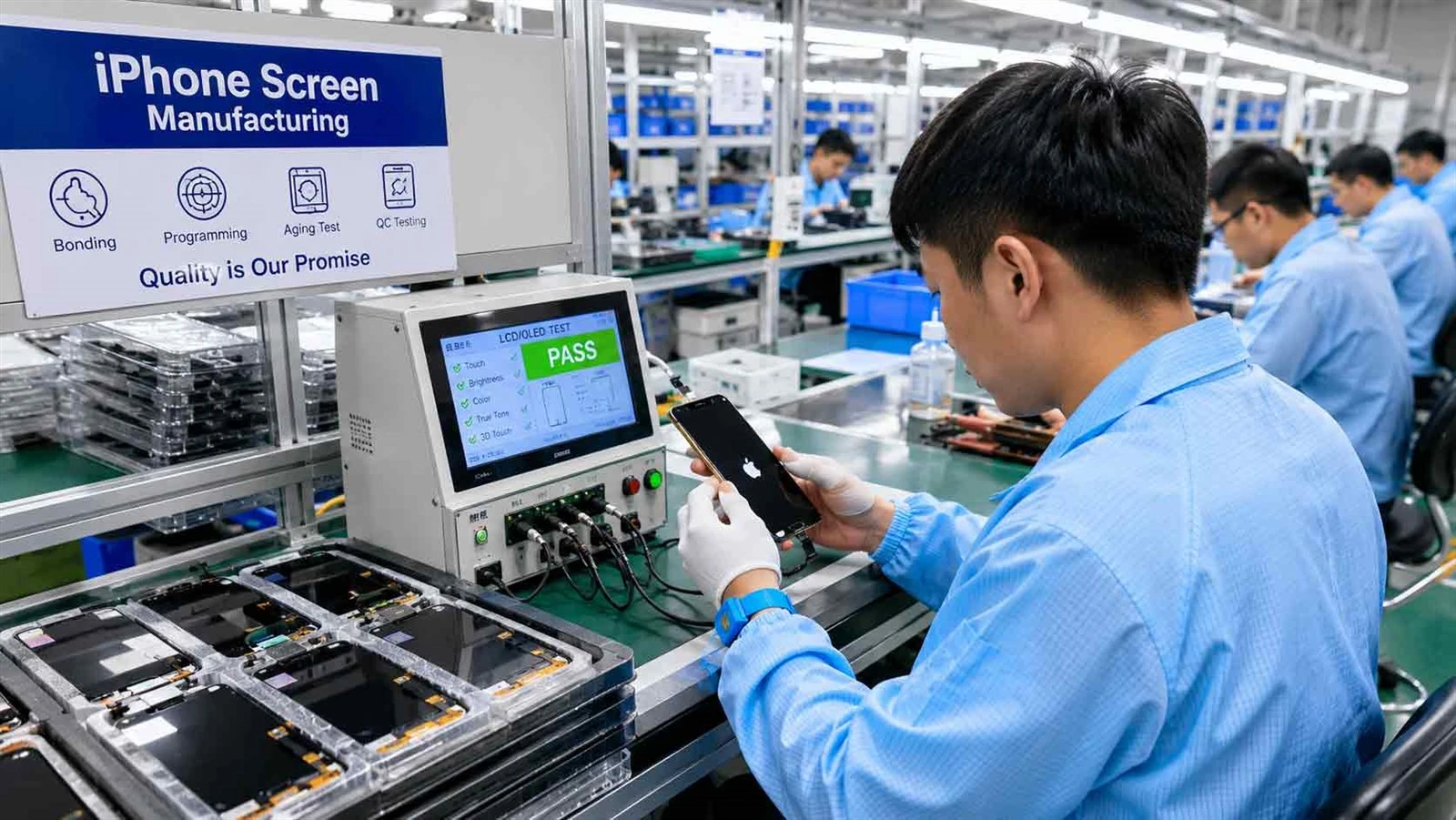
- Ask for a video of the production line - bonding, aging test, programming stations - not a photo of a warehouse. Boxes on a shelf prove nothing.
- Ask for defect data by model and batch. A factory tracks it because its reputation rides on it (we run AQL 1.0–1.5 on touch and display). A trader sends a vague "99.9% pass" with no breakdown.
- Ask a technical question they can't fake - for example, how they handle the "Important Display Message" and True Tone on an aftermarket OLED. If the answer is hand-wavy, you have your answer.
This matters even more for overseas buyers, because you can't walk the floor. The supplier who shows you the process without being chased is the one worth a sample order.
The 8-point checklist to vet any wholesale iPhone screen supplier
Print this. Run every prospective wholesale iPhone screen supplier through it before you wire a deposit.
| # | What to verify | A factory's answer | A red flag |
|---|---|---|---|
| 1 | Own production line | Sends line video on request | Only warehouse photos |
| 2 | QC / defect data | Per-model defect %, AQL standard | "99.9%", no detail |
| 3 | Grade transparency | Tells you what each grade sacrifices | "Same as original" for the cheapest |
| 4 | Sample policy | Encourages a 5–20 unit mixed sample | Pushes you straight to bulk |
| 5 | MOQ flexibility | Flexes for new accounts | Rigid minimums, no movement |
| 6 | After-sales / DOA terms | Clear warranty + who pays return freight | Vague or silent on returns |
| 7 | Export experience | Handles docs, packing, your target country | Has never shipped to your region |
| 8 | Response speed | Replies within hours, in clear English | Slow, copy-paste replies |
A supplier who passes six or seven of these is workable. One who only passes on price is the most expensive screen you'll ever buy.

If you want the deeper version of point 2, we wrote out our full line process here: how we test every iPhone screen before it leaves the factory. And the classic cost-of-cheap-screens story is laid out in why many wholesale buyers lose money even when the price looks great.
Know what you're ordering before you talk price
"iPhone screen" isn't one product. The serviceable lineup splits into LCD models (iPhone 6 through 8, XR, 11, SE) and OLED models (X, XS, and everything from 12 onward), and the grade you pick decides your return rate more than the supplier's logo does.
A quick orientation:
- Incell LCD - the best aftermarket grade for LCD-era iPhones. The touch layer is fused into the LCD, like Apple's original. When a buyer asks me for an Incell LCD screen for iPhone, I always confirm they mean true incell, not the cheaper TFT copy sold under the same name. If a quote is 30% under everyone else, it's TFT.
- Hard OLED - lower-cost rigid OLED for X-series and standard 12/13. Brightness usually below original.
- Soft / refurb OLED - closest to genuine feel and brightness, highest cost, least forgiving of bad flex.
I won't re-explain every grade here because we already broke it down in detail - including real brightness and return-rate numbers - in the truth about iPhone screen grades. Read that before your first order; it'll save you a painful batch.
MOQ, pricing, and what a smart first order looks like
Buyers always want the unit price first. I get it, but price without context is a trap. Your real landed cost is driven by grade, model mix, volume, and return rate - in that order.
What a healthy first order with a new supplier actually looks like:
- Start with a mixed sample, 5–20 units across the models you sell most. Install them yourself. Run them for two weeks before you commit volume.
- Don't front-load one model. Order across 6–8 models, learn your sell-through, then concentrate the reorder.
- Negotiate MOQ directly with the factory. Middlemen quote rigid minimums to protect their own supplier. As a direct manufacturer we'll flex 30–50 units per LCD model and 10–20 per OLED model for a new account, because we'd rather earn your second order than win your first.
On shipping and Incoterms - FOB vs EXW vs DDP, and what each really costs door-to-door - we did a full supplier-side breakdown in buying iPhone LCD screens from China: the real cost breakdown. Worth ten minutes before you compare quotes, because a "cheap" FOB price can land more expensive than a DDP one once freight and duties hit.
Red flags that should end the conversation
After a decade I can usually spot trouble in one thread. Walk away if you see:
- A price that's dramatically below everyone else - something undisclosed got swapped (TFT sold as incell, mixed panel lots, recycled glass).
- No willingness to send a sample, or pressure to "just order a carton to test."
- Silence or deflection when you ask is the panel original, not just the frame?
- Cartons that arrive with mismatched color temperature - half warm, half cold. That's a trader blending three sources. A single factory line doesn't do that.
- No clear answer on who pays return freight for DOA units.
Why sourcing direct makes sense in 2026?
You're not betting on a fad. A few realities shape this category - treat the figures as industry estimates and ranges from our order book and widely cited market data; verify against your own sources before you quote them:
| Reality | Estimate | Why it matters to you |
|---|---|---|
| Active iPhones worldwide | Well over a billion units | A massive, constantly-cracking install base |
| #1 reason for iPhone repair | Cracked / failed screen | Screens are the repair category |
| Aftermarket display/repair growth | Roughly mid-to-high single digits/yr | Steady demand, not cyclical |
| LCD models still in service | Hundreds of millions (6–11/SE/XR) | LCD volume isn't going away soon |
| New serviceable models | Entirely OLED (12 and up) | Where your value is migrating |
The short version: LCD stays huge in volume while OLED grows in value, and the chain keeps shortening as right-to-repair laws expand the independent-repair channel across the EU and US. Buyers who lock in a direct factory now - with transparent QC data - will have cleaner margins by 2028 than those still chasing the lowest sticker price.
How we work with new overseas buyers?
I won't pretend this isn't a pitch - but it's an honest one. As a direct iPhone LCD screen manufacturer, here's what changes when there's no middle layer: you get batch-level QC data, flexible MOQ, in-house True Tone programming, and a real person to call when something goes wrong at scale.
The process is deliberately simple:
Send your model list, quantities, and target country.
- We quote, and you confirm a sample before any bulk commitment.
- We run production with progress updates, then handle export packing and documents.
- Browse the catalog by series - iPhone 11 LCD, iPhone X/XR/XS LCD, iPhone 6–8 LCD, or the full product range - then send us your model list for a quote. Start with a small mixed sample and judge us by the screens, not the sales talk.
Frequently asked questions
How do I tell a real iPhone screen factory from a trader?
Ask for a video of the production and programming line (not the warehouse), batch-level QC defect data by model, and clear DOA/return terms. A genuine iPhone LCD screen manufacturer answers specifically and knows its own defect rate; a trader deflects.
What MOQ should I expect from a wholesale iPhone screen supplier?
It varies by who you buy from. Traders enforce rigid minimums; a factory can flex. We typically start LCD models at 30–50 units and OLED at 10–20 for new accounts, and we recommend a mixed first order so you can learn your sell-through before scaling.
What's the difference between Incell LCD and TFT iPhone screens?
True incell fuses the touch layer into the LCD - better touch, especially in cold climates, and closer to original feel. TFT bonds a separate touch layer on top and is cheaper. They look identical in a listing; they don't behave identically in the customer's hand. Always confirm an Incell LCD screen for iPhone is true incell, not a TFT copy.
Can I order a sample before a bulk order?
Yes - and you should. Request 5–20 mixed units, install them, and run them for two weeks before committing volume. Any supplier who resists a sample is a red flag.
Do aftermarket iPhone screens trigger a warning message?
On newer models, non-genuine screens can show a display or True Tone message and may lose True Tone unless the touch IC is properly programmed. Quality suppliers program the IC so the screen works cleanly - test exactly this in your sample.